
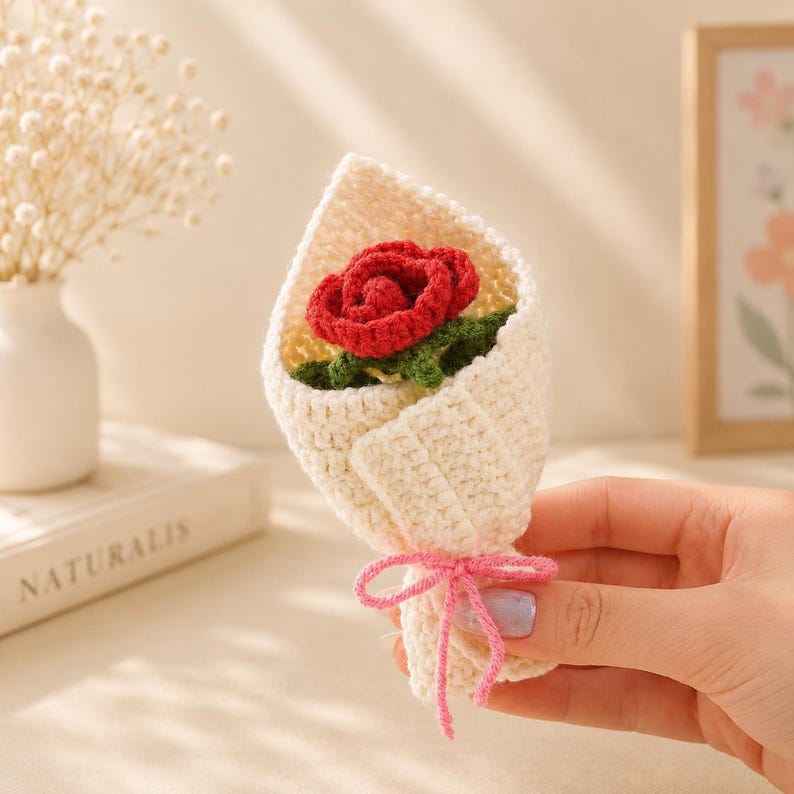
Crochet Rose Bouquet Pattern: A Complete Guide
Quick answer: The Crochet Rose Bouquet Pattern is a beginner-to-intermediate floral project that takes about 4–8 hours to complete, depending on bouquet size. Each rose finishes at roughly 3–5 inches, and the bouquet can be customized in color and stem count for weddings, anniversaries, or any occasion that calls for a timeless, lasting gift.
Crochet Summary Box
| Difficulty | Beginner to Intermediate |
| Estimated Time | 4–8 hours |
| Finished Size | Customizable bouquet; individual roses approximately 3–5 inches (8–13 cm) |
| Main Materials | Worsted-weight yarn (petal color of choice, green for stems/leaves), 3.5mm–4mm crochet hook, floral wire, green floral tape, yarn needle |
| Terminology | US crochet terms |
Table of Contents
- What Roses Symbolize
- Why a Rose Bouquet Makes a Timeless Handmade Gift
- Choosing the Right Yarn and Hook
- Floral Wire and Stem Materials
- Finishing Techniques for the Spiral Petals
- Leaf Construction
- Bouquet Arrangement Ideas
- Color Combinations and What They Mean
- Common Beginner Mistakes to Avoid
- Care Instructions
- Practical Crochet Tips
- FAQ
What Roses Symbolize
Roses are one of the most universally recognized symbols of love, gratitude, and admiration, with a meaning so well established that the flower itself has become shorthand for romance. Beyond romantic love, roses are also given to express friendship, appreciation, and elegance, which is part of why they remain a popular gift across so many different occasions and relationships.
Because a crocheted rose never wilts or loses a petal, that sentiment becomes something a person can hold onto indefinitely. A rose bouquet given as a wedding gift or anniversary keepsake can still be on display decades later, carrying the same meaning it did on the day it was given.
Why a Rose Bouquet Makes a Timeless Handmade Gift
Few flowers carry as much occasion-spanning versatility as the rose. This bouquet pattern suits weddings and anniversaries especially well, since a handmade rose bouquet can double as a keepsake long after the celebration ends. It's equally fitting for Valentine's Day, Mother's Day, and birthdays, where a classic rose bouquet never feels like the wrong choice.
A single rose makes a meaningful, focused gift on its own, while a fuller bouquet of five or more stems becomes a striking centerpiece or a wedding bouquet alternative that the recipient can keep forever instead of pressing or discarding.
Choosing the Right Yarn and Hook
A smooth worsted-weight (US category 4) cotton or cotton-blend yarn is ideal for rose petals, since it holds the rolled, layered shape well and gives a clean, structured finish. Acrylic yarn works as a budget-friendly alternative as long as you choose a tightly spun, smooth variety, since a fuzzy texture can obscure the delicate spiral detail that makes a crochet rose recognizable.
Classic red is the most popular petal color, but this pattern works beautifully in any shade, paired with a medium green for the stem and leaves. A 3.5mm to 4mm hook with worsted-weight yarn gives a fabric firm enough to hold the rolled petal shape without it unraveling or flattening over time.
Floral Wire and Stem Materials
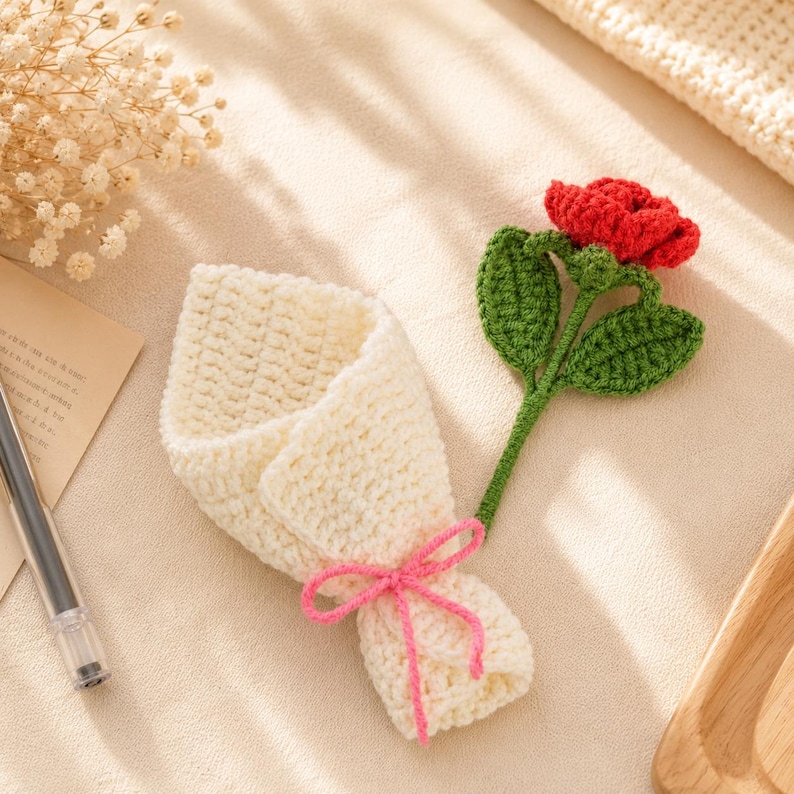
Floral wire gives a crocheted rose its sturdy, upright stem and allows for the slight natural curve many real roses have. Thread a medium-gauge floral wire through the crocheted stem tube before closing the seam, which lets you shape the stem and have it hold its position once arranged.
After inserting the wire, wrap the stem in green floral tape from just below the flower head down to the base. This hides the wire and seam completely, and the slightly tacky texture also helps multiple stems hold together naturally when gathered into a bouquet.
Finishing Techniques for the Spiral Petals
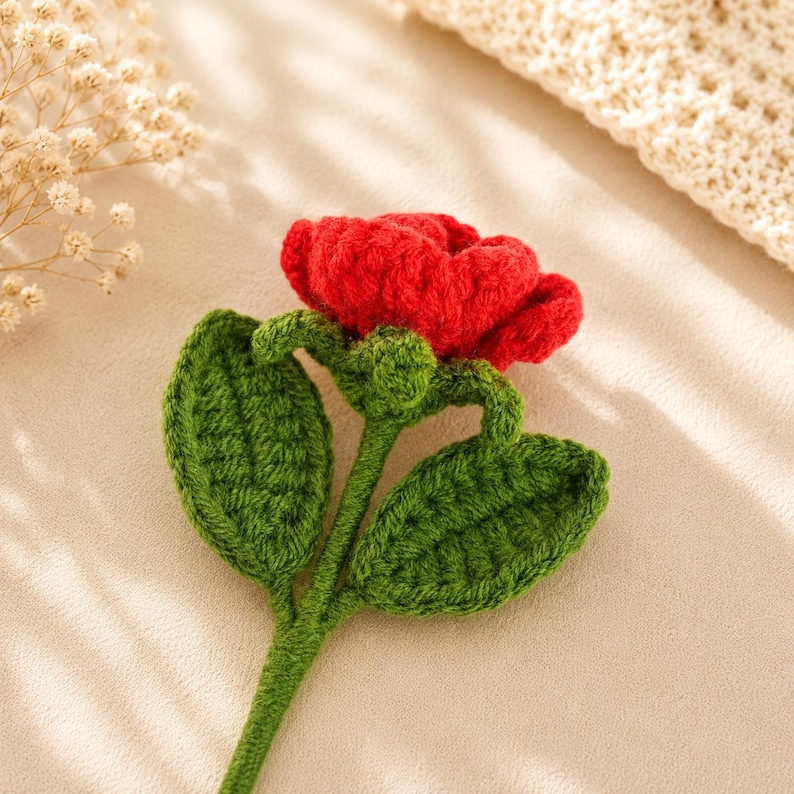
A crochet rose's signature look comes from its spiral or layered petal construction, which is typically worked as a long strip and then rolled and tacked into place to create the rounded, blooming shape. When assembling, roll the strip with even, consistent tension so the petal layers don't bunch unevenly on one side, and secure the base with several small stitches through all layers so the rose holds its shape under normal handling.
Take your time with this step, since the rolling technique is what gives a crochet rose its realistic, dimensional look compared to a flatter flower shape.
Leaf Construction
Rose leaves are typically worked as small, pointed leaf clusters of three, mimicking the way real rose leaves grow in groups along the stem. Attach a leaf cluster a short distance below the flower head, and add a second cluster further down the stem if you'd like a fuller, more realistic look, especially for longer-stemmed roses intended for a formal arrangement.
Bouquet Arrangement Ideas
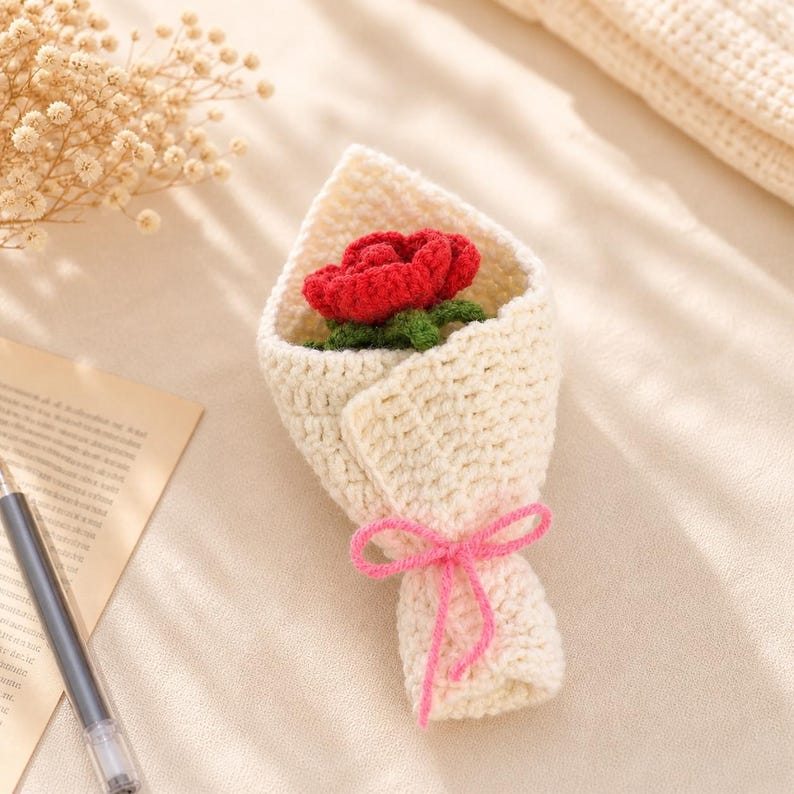
A classic dozen-style bouquet of roses gathered together and wrapped in paper or ribbon remains one of the most recognizable and meaningful floral gifts, and a crocheted version carries that same visual impact without the cost or short lifespan of fresh-cut roses. For a smaller gift, a trio of roses tied with a simple ribbon makes an elegant, understated arrangement.
For a fuller, mixed bouquet, roses pair well with other florals for added texture and color variety. Combining them with a crochet sunflower bouquet or a crochet tulip bouquet creates a richer, more layered arrangement than roses alone.
Color Combinations and What They Mean
Rose color carries its own well-known symbolism, which makes choosing a petal color part of the gift itself. Red roses are the classic symbol of romantic love, while pink roses often represent gratitude, admiration, or gentler affection. Yellow roses are traditionally associated with friendship and joy rather than romance, and white roses carry meanings of purity, new beginnings, and remembrance.
Because this is a handmade pattern, you can also mix several colors within a single bouquet, for example combining red and white roses for an anniversary gift, or pink and yellow for a friendship-focused arrangement.
Common Beginner Mistakes to Avoid
- Rolling the petal strip too loosely: a loose roll can unravel or look messy. Roll with firm, even tension and secure thoroughly at the base.
- Uneven petal layering: if the strip isn't rolled at a consistent angle, the finished rose can look lopsided rather than evenly blooming.
- Skipping the floral wire: without wire, the stem won't hold a pose, which makes arranging multiple roses into a bouquet more difficult.
- Rushing the base stitching: a rolled rose needs several secure stitches through all layers at the base, or it can loosen and unroll with handling over time.
Care Instructions
Dust finished roses gently with a soft, dry cloth, or use a hairdryer on a cool, low setting held at a distance. The floral wire inside each stem allows any bent stem to be reshaped back into position whenever needed. To keep colors looking their richest, avoid displaying finished bouquets in direct, constant sunlight for long periods.
Practical Crochet Tips
- Crochet all petal strips for a multi-stem bouquet in the same sitting to keep your tension and strip length consistent across every rose.
- Practice the rolling technique on a single test rose before committing to a full multi-stem bouquet, since this step has the steepest learning curve in the pattern.
- Lay your gathered stems out flat before tying the final bouquet so you can adjust color order, height, and angle while everything is still loose.
- If you'd like to build a larger, more varied arrangement, our crochet narcissus bouquet pattern adds a softer, early-spring contrast alongside roses.
Frequently Asked Questions
Do I need floral wire for this pattern?
Floral wire is recommended so the stem holds its shape and pose. Without it, the stem will be soft and won't stand upright.
How many roses make a full bouquet?
A trio of roses makes an elegant smaller gift, while six to twelve stems creates a fuller, classic bouquet look.
What occasions suit a rose bouquet best?
Roses suit weddings, anniversaries, Valentine's Day, and Mother's Day especially well, with color choice letting you tailor the sentiment to the occasion.
Can I mix multiple rose colors in one bouquet?
Yes. Combining colors, such as red and white for an anniversary or pink and yellow for a friendship gift, is a simple way to personalize the bouquet's meaning.
Can I combine roses with other crochet flowers?
Yes. Roses pair especially well with sunflowers and tulips for a fuller, mixed-bouquet look with more texture and color variety.
Is this pattern suitable for a true beginner?
The individual stitches are beginner-friendly, but the rolling technique for the petals takes some practice, so this pattern is best suited to someone comfortable with basic flower-crochet construction.
If you'd like the complete written pattern with full stitch-by-stitch instructions for the petals, leaves, and stem assembly, you can find it as a printable PDF on Etsy.